Archives for posts with tag: general theory of the west

joshua keating wrote on his foreign policy blog last week:

Questions you never thought to ask: Is inbreeding bad for democracy?

heh. (~_^)

well, some of us HAVE thought to ask that very question, a couple of people waaaay before i did — going back to 2002 in fact:

- Consanguinity prevents Middle Eastern political development from parapundit.
- Cousin Marriage Conundrum – from steve sailer. steve’s essay was also included in a volume co-edited by steven pinker, The Best American Science and Nature Writing 2004.

keating is referring to the woodley and bell paper, Consanguinity as a Major Predictor of Levels of Democracy: A Study of 70 Nations, which was published last year and which i blogged about here (and here and here and here) — and steve sailer also blogged about at the time.

just to refresh everyone’s memory, woodley and bell found a negative correlation (r = –0.632, p < 0.001) between the frequency of consanguineous marriages in the 70 nations at which they looked and the level of democracy in those countries. in other words, the greater the amount of consanguineous marriages in a country, the less democracy it probably has.

keating is not convinced:

“As a counterpoint, Iceland — a country so isolated and sparsely populated that people need an Android app to keep them from hooking up with a close relative — has had a representative parliament since the 10th century and a culture of individualism so strong they write Nobel Prize-winning novels about it. So there.”

two things.

first of all, it should be remembered that woodley and bell specifically looked for success at liberal democracy (fwiw, ymmv). from the paper:

“As conceived here, democracy refers to a system in which there is opportunity for competitive elections and deliberative referendums, with broad public participation encouraged for both (Vanhanen, 2003). Democracy in this instance refers exclusively to the liberal variety where the emphasis is on competitive politics, rather than the classical type in which the focus is on consensus building and statesmanship (Werlin, 2002). Two key characteristics of liberal democratic systems include the presence of institutions that permit citizens to express preferences for alternative policies and leaders, and the existence of institutionalized constraints that prevent the misuse of power by an executive elite (Inglehart, 2003; Lipset, 1959; Marshall & Jaggers, 2010).”

secondly, tenth century icelandic democracy was not an example of liberal democracy — and wasn’t right through to 1262 when the norwegian crown took over the governance of iceland. rather, the icelandic commonwealth was a system based on consensus which i posted about previously here.

early medieval icelanders were represented at their alþingi by regional chieftans known as goðar. nobody elected these goðar — they were the local strongmen from various areas of iceland, and they typically inherited their position, although these chieftainships were sometimes sold. you could, in theory, pick your own goði to whom you swore allegiance, but apparently in practice this rarely ever happened — because a lot of medieval icelanders were kin to their goðar [pdf], and it’s almost always bloody awkward to break it off with family — especially when you can’t easily move to the other side of the island or something.

so these early medieval icelandic “representatives” bore little resemblance to the representatives we have in modern, parliamentary systems (h*ck – maybe that was a good thing!). if you were an early medieval icelander, your alþingi representative was likely your kin, and you were probably stuck with him for life — until his son took over. this was not liberal democracy.

did the early medieval icelanders marry their cousins? i’m not sure. it’s very likely that their immediate ancestors from norway did (like the early medieval swedes probably did), and the medieval icelanders ignored many other of the church’s teachings and regulations on marriage at the time [pdf], so i wouldn’t be surprised if they did. the fact that medieval icelandic society seems to have devolved from one in which kinship was comparatively unimportant to a state where large clans controlled the place also suggests to me that they married their cousins — or at least mated awfully closely (they may not have had to marry very close cousins since they were such a small population to start off with).
_____

having said all that, when trying to work out why the medieval icelanders — or any other group for that matter — didn’t/don’t have liberal democracy, it’s not really important whether or not they were marrying their cousins at the time in question. well, it is … and it isn’t. (don’t pull your hair out just yet.)

what is important (i think) is whether or not the medieval icelanders — or any group-X — had been marrying their cousins over the long-term. i don’t think that there’s an instantaneous connection between cousin marriage (or other close mating) and failing to manage a functional liberally democratic system. what i think that there is are longer term evolutionary processes connected to inbreeding/outbreeding patterns and the selection for individualism vs. familism or clannism. and if you have clannism, liberal democracy will just not work.

woodley and bell acquired their consanguinity data from consang.net. here’s a map of those data:

consang net

what stands out right away is that consanguinity rates are very high in the arab world, the middle east, north africa, and places like pakistan and afghanistan, while rates are really low in the u.s. and scandinavia. that seems to fit the cousin-marriage-doesn’t-promote-democracy theory. but the cousin marriage rates in china are very low — same range as england and western europe. why don’t the chinese manage to have a liberal democracy then?

what you have to understand is that this map is a snapshot. it is a moment in time (mostly the twentieth century). it doesn’t tell us much about the history of cousin marriage in any of these societies — whether any of it’s been short-term or long-term — and without knowing that, we can’t even start to guess at any effects the mating patterns (and related family types) might’ve had on the evolution of behaviors in these populations, including those related to clannishness.

once you know, for instance, that up until very recently, the chinese actually preferred cousin marriage, then you can — i think — begin to understand why they’re clannish (or, at least, extended family-ish). and why, therefore, liberal democracy doesn’t work there — or didn’t arise there in the first place either.

rinse and repeat for all the other locales on the map.
_____

see also Cousin Marriage and Democracy @marginal revolution.

previously: liberal democracy vs. consensus building and democracy and endogamous mating practices and “hard-won democracy”

(note: comments do not require an email. driving in iceland.)

in “Family Structure, Institutions, and Growth: The Origins and Implications of Western Corporations,” stanford economist avner greif wrote [pgs. 308-09]:

“There is a vast amount of literature that considers the importance of the family as an institution. Little attention, however, has been given to the impact of the family structure and its dynamics on institutions. This limits our ability to understand distinct institutional developments — and hence growth — in the past and present. This paper supports this argument by highlighting the importance of the European family structure in one of the most fundamental institutional changes in history and reflects on its growth-related implications.

“What constituted this change was the emergence of the economic and political corporations in late medieval Europe. Corporations are defined as consistent with their historical meaning: intentionally created, voluntary, interest-based, and self-governed permanent associations. Guilds, fraternities, universities, communes, and city-states are some of the corporations that have historically dominated Europe; businesses and professional associations, business corporations, universities, consumer groups, counties, republics, and democracies are examples of corporations in modern societies….

“In tracing the origins of the European corporations, we focus on their complementarity with the nuclear family. We present the reasons for the decline of kinship groups in medieval Europe and why the resulting nuclear family structure, along with other factors, led to corporations. European economic growth in the late medieval period was based on an unprecedented institutional complex of corporations and nuclear families, which, interestingly, still characterizes the West. More generally, European history suggests that this complex was conducive to long-term growth, although we know little about why this was the case or why it is difficult to transplant this complex to other societies….

“The conquest of the Western Roman Empire by Germanic tribes during the medieval period probably strengthened the importance of kinship groups in Europe. Yet the actions of the church caused the nuclear family — consisting of a husband and wife, children, and sometimes a handful of close relatives — to dominate Europe by the late medieval period.

The medieval church instituted marriage laws and practices that undermined kinship groups…. The church … restricted marriages among individuals of the same blood (consanguineous marriages), which had historically provided one means of creating and maintaining kinship groups….

“European family structures did not evolve monotonically toward the nuclear family, nor was their evolution geographically or socially uniform (Greif, 2006, chap. 8).** By the late medieval period, however, the nuclear family was dominant. Even among the Germanic tribes, by the eighth century the term ‘family’ denoted one’s immediate family and, shortly afterwards, tribes were no longer institutionally relevant. Thirteenth-century English court rolls reflect that even cousins were as likely to be in the presence of nonkin as with each other. The practices the church advocated (e.g., monogamy) are still the norm in Europe. Consanguineous marriages in contemporary Europe account for less than 1 percent of the total number of marriages, in contrast to Muslim and Middle Eastern countries where such marriages account for between 20 and 50 percent per country (Alan H. Bittles, 1994). Among the anthropologically defined 356 contemporary societies of Euro-Asia and Africa, there is a large and significant negative correlation between the spread of Christianity (for at least 500 years) and the absence of clans and lineages; the level of commercialization, class stratification, and state formation are insignificantly correlated (Andrey V. Korotayev, 2003).”
_____

the presence (or absence) of clans in societies is somehow connected to the mating patterns of societies. in fact, it seems to be that a whole range of kinship-based societal types is somehow connected to a whole range of mating patterns: the “closer” the mating patterns in a society, the more “clannish” it tends to be — the more distant the mating patterns, the less “clannish.”

so we see a spectrum of “clannish” societies ranging from the very individualistic western societies characterized by nuclear families and, crucially, very little inbreeding (cousin marriage, for instance) to very tribal arab or bedouin societies characterized by nested networks of extended families and clans and large tribal organizations and having very high levels of inbreeding (specifically a form of very close cousin marriage which increases the degree of inbreeding). falling somewhere in between these two extremes are groups like the chinese whose society is built mostly around the extended familiy but in some regions of china also clans — or the medieval scots (especially the highland scots) whose society for centuries was built around the clan (h*ck, they even coined the term!). these “in-betweener” groups are, or were, characterized by mid-levels of inbreeding (typically avoiding the very close cousin marriage form of the arabs).

furthermore, not only do the degrees of extended family-ness/clannish-ness/tribal-ness in societies seem to be connected to the degrees of inbreeding in those societies, the degrees of “clannism” also seem to be connected to the degree of inbreeding — the more inbreeding, the less civicness, the less democracy, the more corruption, and so on.

it’s not clear what exactly the mechanism(s) behind this inbreeding-leads-to-clannishness pattern is, but since mating patterns are involved, and mating is a very biological process, it seems likely (to me anyway) that the explanation is something biological — i.e. some sort or sorts of evolutionary process/es — like natural selection — resulting in different/different degrees of behavioral traits related to “clannism” in different populations with inbreeding acting as a sort of accelerant for those processes.

clans and clannism, then, are not things that peoples “fall back on” in the absence of a state as mark weiner suggests in The Rule of the Clan [kindle locations 106-108]:

“[I]n the absence of the state, or when states are weak, the individual becomes engulfed within the collective groups on which people must rely to advance their goals and vindicate their interests. Without the authority of the state, a host of discrete communal associations rush to fill the vacuum of power. And for most of human history, the primary such group has been the extended family, the clan.”

rather, people’s attachments to their extended families/clans/tribes — and, more importantly, their tendencies towards clannish behaviors — are likely innate behaviors. and those behaviors likely vary, on average, between populations since (long-term) mating patterns have varied — and, indeed, still vary — between populations.

such innate behaviors cannot be changed overnight — certainly not within a generation or even two (evolution does take some amount of time — but not, necessarily, extremely long amounts of time either) — and definitely not by simply changing a few laws here and there in the hopes of encouraging individualism. as avner greif grasped, although probably not fully because he’s likely missed the underlying biology of what he’s noticed, family structures need to be altered in order to effect changes to larger societal structures (again, all via tweaks to innate behavioral tendencies). and, again, that can’t be done overnight — as greif pointed out, the process in europe began in the early medieval period (with the church’s bans on cousin marriages) and didn’t really start to take hold until the late medieval period — i.e. a 500 year (or, conservatively, a ca. 25 generation) timeline.
_____

see also: Cousin Marriage Conundrum by steve sailer and Why Europe? by michael mitterauer (in particular chapter 3) and Institutions and the Path to the Modern Economy: Lessons from Medieval Trade by avner greif.

**see “mating patterns in europe series” in left-hand column below ↓ for further details.

(note: comments do not require an email. busy clan members.)

i know, i know — it’s easier to spot inbreeding (or outbreeding) from the presence (or absence) of a lot of long runs of homozygosity (roh) in the genomes of individuals in a population rather than short roh (see for example the central/south and west asians in this post, populations which everyone knows are regular inbreeders), but i haven’t got any data on long roh for separate, sub-populations (like italians vs. europeans), so we’re gonna have to make do with short roh (for now). and anyway, even the amount of short roh is reduced via outbreeding (and increased via inbreeding), so you can use it as a tool to try to work out a population’s mating history. it’s just not as easy/obvious as with longer roh.

so … the map below is taken from Genomic and geographic distribution of SNP-defined runs of homozygosity in Europeans.

the samples come from:

- the rotterdam study – the netherlands
- popgen – northern germany – specifically the schleswig-holstein region (in deutsch if you like)
- the monica augsburg surveys – southern germany – from the city of augsberg and two neighboring counties
- and popres, which, since this is a study of europeans, i presume must mean that the samples came from both the lolipop study in london and the colaus study, lausanne, switzerland — i discussed those two studies in this previous post (scroll down).

again, the problem with taking samples from people living in big cities is that, even if they may be natives of whatever country they happen to live in, they, or some of their recent ancestors, may have migrated to the city — so, who knows, for instance, if the samples from rotterdam tell us anything about rotterdam or even the region of the country in which rotterdam is located. probably tells us something about the dutch, but even then….

these researchers — nothnagel et al. — chose to look at roh that were 1Mb in length. that’s shorter than the 1.5Mb roh as delineated by the researchers who looked at the roh in russian populations. also, nothnagel et al. weighted the average roh in each population according to how much linkage disequilibrium was (estimated to be) present in each population. don’t ask! no, really — don’t ask, because i don’t really understand why they did this. here’s the wikipedia page for linkage disequilibrium. i know that you can have more ld in an inbreeding population and — you guessed it! — less in an outbreeding one. and, of course, other things like bottlenecks can affect how much ld is present in a population. nothnagel et al. found different amounts of ld in the populations in this study and compensated for that, but again i’m not exactly sure why.

anyway … here’s what they found. this map shows the subpopulation averages of the weighted number of roh per individual (the contour lines are guesstimates — educated guesstimates, but still guesstimates):

europe roh - average weighted ROH number per individual

if you look closely, you’ll see that there’s a sort-of central band of a relatively low average number of roh (between 37-39) that runs from southern england down through beligum/the netherlands (rotterdam) and northeast france, southern germany and switzerland. and, as the researchers observed, and as we saw in the previous post on russia, the numbers of roh increase going northwards and decrease going south. until you get to southern spain and southern italy, southern greece, and (probably) a central spot in the balkans there, all regions where the average number of roh increases again. the researchers suggest that, perhaps, migration from northern africa to the iberian peninsula (that’s the only region for which they offer a possible explanation for this anomaly) explains the longer roh there — presumably they’re thinking of a bottleneck. maybe. but perhaps it’s due to greater historic inbreeding in southern spain — and southern italy and greece and the balkans. some data showing longer roh would help us tell one way or the other.

the researchers, btw, acknowledge that the areas indicated as having very low amounts of roh — colored in the lightest shades of yellow — i.e. northwest spain and eastern europe — are probably artifacts of the interpolation method that they used. also, for all you scots out there (you know who you are! (^_^) ), while i do predict that the average numbers of roh in scotland ought to be higher there than in england, note that there was no data for scotland included in this study, so the shades of the contours up there are wild guesses as well.

i’m quite surprised by the very low levels of roh in romania, but remember that one has to read this map with the underlying north-south differences in numbers of roh in mind, so perhaps the roh in romania really indicates an inbreeding/outbreeding rate in romania that is more like that found in, say, france/germany. dunno. in any event, it’s very interesting.

now i want to compare the average number of roh in eastern europe with western europe. that’s going to be kinda hard to do since 1) the two studies used different roh lengths (1Mb vs. 1.5Mb), and 2) the numbers from this study have been weighted. still, i think we can get at something of a (very!) rough picture by taking the numbers from germany as our starting point and using them to calibrate the results from the two studies. we can do this, i think, since the samples from germany came from the same sources in both studies — the popgen study for northern germany and the monica study for southern germany.

in the russian study, the samples from northern and southern germany were combined, so we only have one number for germany — which was lower than all the results from eastern europe, typically much lower (see map from previous post). the number of roh in the polish sample, for instance, was more than twice that found for the germans. the average number of roh in russia (Rus_HGDP) was also twice that of the germans. czechs, latvians, estonians — all higher than the germans.

now if we work westwards from germany using the results from the study in this post — the english, the dutch (rotterdam), and the swiss are all in the same range as the southern germans, while the southern french have an even lower average number of roh — and the irish (in dublin) and the czechs are in the same range as the northern germans. so all of these populations — and even the spanish and italians — have fewer roh on average than eastern europeans. which is what i would’ve guessed given what we know about the historic mating patterns of europeans beginning in the early medieval period (see mating patterns in europe series below ↓ in left-hand column).

maybe there’s another explanation for this difference between western and eastern europe — and for the apparent differences between central and southern europe. like i said above, a study or two looking at longer roh would help to clear up the picture one way or the other.

previously: russians, eastern europeans, runs of homozygosity (roh), and inbreeding and ibd and historic mating patterns in europe and ibd rates for europe and the hajnal line and runs of homozygosity and inbreeding (and outbreeding) and runs of homozygosity again

(note: comments do not require an email. ruh roh!)

below are a few quotes from Unjust Seizure: Conflict, Interest, and Authority in an Early Medieval Society regarding some historic evidence for blood feuds and honor killings in early medieval bavaria, the historic evidence being in the form of ecclesiastical charters (recording property donations to the church) and tales from a saint’s life. the time period is the mid-700s.

first of all, the “bavarians” of the day were a mix of peoples — mostly germanics (including alamanni, lombards, thuringians, and goths) but also some romans (or romanized locals) and slavs. the local rulers were a bunch of franks (iow, also germanics) who had taken over the place on behalf of the merovingians (no, not this guythese guys) — and introduced the manor system (uh oh!).

the conversion of the natives of bavaria (i.e. not their frankish rulers) to christianity was completed by st. boniface (boo!) sometime in the early 700s, so these people probably had had no barriers to marrying their cousins right up until the time period under discussion below (unless some of the local romans/romanized locals had been christians?). the agilolfings, too — the frankish rulers of bavaria — probably hadn’t been christians for much longer either, most of the franks converting in the 500-600s. so the population of bavaria in the 700s was probably not very outbred at that point (these things take time).

however, the church already had its cousin marriage bans in place by this time, so there probably would’ve been pressure from the priests and bishops and monks in the 700s to stop any close matings that were going on. there is some documentary evidence that shows that marriages in the 700s on ecclesiastical manors in bavaria occurred between such manors [pgs. 217-48], so that might suggest that the church at this time was, indeed, discouraging close marriages. i couldn’t find an online copy of the lex baiuvariorum (in english), which was written in the mid-700s, so i don’t know if there were any secular laws against cousin marriage in bavaria at this time.

the interesting points in the following are that: 1) feuds between clans, and even between branches of clans, were happening in eighth century bavaria just like you might’ve found in scotland in the fifteenth and sixteenth centuries (thanks, mel!) or in parts of the philippines … like … just the other day — iow, early medieval bavarians were clannish peoples; and 2) family honor was extremely important to the point where honor killings happened just like — or almost like — in the arab world/middle east today.

ok. here are those excerpts [pgs. 30-39 - links added by me]:

“To begin with, we have the charters from the cathedral church at Freising. Five of the approximately one hundred twenty Freising charters surviving from this period [pre-carolingian] mention conflict…. The five Freising records tell a variety of stories. Nevertheless, they have one important feature in common: all mention conflicts tangentially, that is, as incidents that did not involve the church directly but rather prompted someone to make or confirm a property gift to the church….

“Instead of showing the church as a party to conflict, the Freising charters from this period reveal members of landholding kindreds in conflict with one another. Some of this conflict was violent. We learn of it because two men who were attacked and seriously wounded, as well as a third man whose son was killed, gave property to the church to benefit their souls and to support members of their families. The charters recording these gifts do not say what the violence was all about. The stories they tell, however, suggest that the attacks resulted from feuds between kindreds, and possibly even within an extended kin group. This impression is strengthened by Bishop Arbeo of Freising’s ‘Life of Saint Emmeram’. Arbeo’s biography of Regensburg’s patron saint is built around a story of outraged honor and violent revenge. The story indicates that Bavarian aristocrats in this period regarded violence as a legitimate response to insult or injury….

“The conflicts appear in the charters because the parties ended them by giving the disputed property to the church or by rearranging or restating disputed property rights that involved the church….

“Violence

“At the beginning of the Freising charter collection, between his table of contents and his prologue, the priest Cozroh place a copy of a charter that he titled in red ink, ‘The Gift of Haholt and His Son Arn’. The charter was produced at the monastery of Saint Zeno at Isen, some thirty-two kilometers southeast of Freising, on May 25, 758. It most likely earned its prominent position in the collection, and certainly the attention of modern scholars, because it records among other things the dedication of Arn, the future archbishop of Salzburg and confidant of Charlemagne, to an ecclesiastical career.

“This record tells of a property gift that Arn’s father, Haholt, made to the cathedral church at Freising. At some time in the past, we read, an unnamed person attacked Haholt and seriously wounded him, to the point that he feared for his life. On what he thought was his deathbed, Haholt gathered his relatives together and asked them how best to provide for his soul and for his son’s future. Haholt’s kinsmen advised him to summon Bishop Joseph of Freising. The bishop hurried to Haholt’s bedside. On Joseph’s advice, Haholt ordered a church built on property he owned near Isen, which the bishop consecrated. Then, with the consent and participation of his wife, son, and relatives, Haholt gave the church and the property to Freising. He did so under the condition that his son Arn have the use of the property, that is, hold it from Freising as a benefice, for the rest of his life. After a space of time, however, Haholt recovered from his wound. In gratitude for God’s mercy and for their souls’ salvation, Haholt and his wife personally confirmed the gift. In addition, they formally devoted Arn to a clerical life at the Freising cathedral church.

“This record tells us that an unknown person attacked Haholt. The attack, however, is not the charter’s main concern, and we learn nothing about Haholt’s assailant or the reason for his assault. We learn only that the attack prompted Haholt and his wife to give property to Freising for the benefit of their souls and to support their son in his new career.

We can nevertheless hazard a guess about why Haholt was wounded. Two other charters suggest that he was involved in a feud. In the year 763, a kindred headed by a man named Reginperht and his brother Irminfrid turned a church they had built at Scharnitz, in modern-day Tyrol, into a monastery. Members of the kindred endowed the new foundation with generous gifts of property. One man, named Cros, had a special reason for his gift. ‘Compelled by the admonition of God and struck down by Count Keparoh with an incurable wound,’ Cros gave all his property to the monastery and entered it himself as a monk.

“Here, as in the Haholt charter, an act of violence prompted its victim to make a property gift. This time we have a name for the attacker: Count Keparoh. The name Keparoh also appears in another charter, this time on the receiving end of a violent attack. In this record, from the year 774, a man named Onulf makes the statement that his favorite son, Keparoh, had been insidiously murdered. Onulf responded to his son’s death by giving the property his own father had left him, as well as that left his wife by her father, Keparoh, to the Freising cathedral church. The property was to support his wife and surviving son for their lifetimes.

Onulf’s gift charter and the Scharnitz foundation charter together provide evidence for a feud stretching over generations. In 763, Count Keparoh struck down Cros. Eleven years later, in 774, a Keparoh fell victim to an assault. This younger Keparoh had a grandfather who was also named Keparoh. It is entirely possible that the person who attacked the younger Keparoh was a partisan of Cros and that the younger Keparoh’s grandfather was related to the count who attacked Cros or was even the count himself. In each case, the attacks prompted property gifts to a kindred monastery or to the cathedral church at Freising.

It turns out that Cros and the Kepharohs were most likely related to each other.

so this feud lasting for generations was likely a feud between sub-clans.

“To give a brief example of what the evidence behind such a statement looks like: Cros was the kinsman of the principal Scharnitz founders Reginperht and his brother Irminfrid. Reginperht and Irminfrid had another brother named David, who witnessed the foundation at Scharnitz. David also appears with Irminfrid making another property gift sometime between 758 and 763. In this latter gift, the name Keparoh stands third among the witnesses, immediately following David and Irminfrid. Given his prominent position on the witness list, it is extremely likely that this Keparoh was related to David and Irminfrid and therefore also to Reginperht and Cros. Keparoh’s apparent kindred relationship to the Scharnitz founders, therefore, suggests that the feud was a violent conflict within an extended kin group.

“The Cros-Keparoh feud helps explain the Haholt charter. Since the Cros and Keparoh stories are very similar to Haholt’s, it makes sense to conclude that Haholt too was wounded in the course of a dispute with another aristocrat. Seens as a group, then, the three charters indicate that Bavarian landowners processed disputes at least in part through violent feud. They do not, however, give any details about the feuds or the disputes that prompted them. To add depth to our picture of feud in Agilolfing Bavaria, we must briefly leave the charters and turn to the life of a saint.

“As noted previously, we have at our disposal two saints’ lives written by Bishop Arbeo of Freising, who succeeded Bishop Joseph in 764. One of them, the ‘Life of Saint Emmeram’, has violent conflict as its centerpiece. Arbeo wrote his biography of Emmeram, the patron saint of the cathedral church and monastery at Regensburg, sometime around the year 772. He evidently had little direct information about Emmeram to go on; he paints his subject for the most part in broad strokes that rely heavily on older hagiographic models. According to Arbeo, Emmeram was a wealthy Gallo-Frankish nobleman who was born in the Aquitanian city of Poitiers sometime in the seventh century. By virtue of his sanctity and his generosity to rich and poor alike, he quickly rose to become bishop of that city….

“After missionizing in Bavaria for three years, Emmeram asked permission to go on a pilgrimage to Rome. Before he could leave, however, Ota, daughter of Duke Theodo, enters the story. Driven by lust and the urging of the devil, Ota had allowed herself to be seduced by the son of one of the duke’s judges. When the young woman could no longer hide the resulting pregnancy, the despairing couple threw themselves at Bishop Emmeram’s feet, admitted their sin, and implored him for aid. Moved by pity, the bishop ordered the pair to do penance for the salvation of their souls. He also instructed them under oath of secrecy to place the fault publicly for Ota’s pregnancy on him so that they might more easily escape earthly death. The bishop took the blame because he knew that when the sin became known, ‘he would certainly be unable to obtain forgiveness for the pair from the girl’s father.’ Emmeram then set out for Rome in the company of a group of clerics….

“Meanwhile, Duke Theodo had discovered his daughter’s condition. Enraged, he would have drawn his sword to kill the baby in the womb had not his men restrained him. No such restraint hindered Ota’s brother Lantperht from avenging his sister’s dishonor. Filled with wild fury, he assembled his own following and set off after Emmeram’s party. On reaching Helfendorf, Lantperht had the bishop brought before him and showered him with angry accusations. The bishop calmly denied the charge of seduction and asked that he, along with whatever companion Lantperht might choose, be allowed to proceed to Rome to seek a judgment from the pope according to church law. Lantperht refused; instead, he had the bishop stripped and tied to a ladder. Lantperht’s men then began to cut off Emmeram’s extremities and limbs piece by piece while the bishop praised God and prayed for their salvation. They finished by ripping off Emmeram’s genitals and tearing out his tongue; leaving the mutilated torso to die, Lantperht and his men departed….”

here’s emmeram having a foot, and who knows what else, chopped off:

Emmeram

As suggested before, Arbeo had to construct a martyrdom story that made sense to his audience out of bits and pieces of tradition, topoi, the cultural language of his society, and his own imagination. He responded by translating the Christ story into one of martyrdom by the ethic of feud. Lantperht viewed the bishop’s alleged seduction of his sister as an assault on his family’s honor. He responded with an act of revenge that he and at least a majority of his followers clearly perceived as justified: he exploded with rage, assembled a war band, and hunted down his sister’s ravisher. Lantperht then had the bishop mutilated and tortured to death. The grisly process ended with a symbolic gesture directly related to the alleged crime, namely, Emmeram’s castration.

This narrative suggests what may have lain in the silences left by the Freising feud charters: an insult, rage, and a violent, symbolic response….

(note: comments do not require an email. the merovingian.)

if you haven’t been following along, i’ve been trying to find out as much as possible about medieval germanic kinship and kindreds with the idea that there might be something there to help explain why the germanic populations seem to have went along with the church’s/kings’/princes’ medieval outbreeding project with the most enthusiasm.

most of the populations of peripheral europe — the scots & the irish, the iberians & maybe even the southern french, the southern italians, eastern europeans to differing degrees, and especially the balkan populations (see Why Europe? and the mating patterns in europe series in left-hand column below ↓ for more details) — took up the outbreeding project much later than nw europeans, with the result (i think) that most of them remained “clannish” to some degree or another, or even tribal like the albanians and montenegrins, up until comparatively recently. was there something different about the germanic societies that predisposed them to adopting the cousin marriage bans of the various medieval religious and secular authorities? were they already kinda outbred, perhaps, pre-the arrival of christianity…?

i said in my previous post on medieval germanic kindreds that i wasn’t having much luck finding any recently published info about them, so i was reading a book on germanic kindreds published in 1913(!) (reprinted in 2010, mind you). well, now i’ve come across a whole gaggle of more recent sources (yay!) — in william jervis jones’ German Kinship Terms, 750-1500: Documentation and Analysis (mentioned previously in this post, btw).

jones thoughtfully summarized the current (as of 1990 when his book was published) thinking on medieval germanic kindreds. here’s what he had to say [pgs. 80-82]:

“Social and legal historians have long debated the size, nature and function of early Germanic and medieval German kin groups. The traditional, though by no means unquestioned, assumption has been that early Germanic society was dominated by the clan or lineage, and by unilinealism, a fabric which was then alleged to have dissolved in the age of the barbarian kingdoms.[5] Fleckenstein (1978: 2ff.) distinguishes here the agnatic and the cognatic clan, and argues in favour of assuming the early existence of the clan as a ‘rather flexible institution’, which was later circumscribed by royal power, overshadowed by more powerful social groupings, and transformed into the lineage and the family. Murray (1983), on the other hand, finds no compelling reason to think that the (for him) mainly cognatic medieval systems were born of a unilineal system in transition: ‘Probably Germanic society always displayed a variety of kinship forms, and various peoples developed systems to meet specific needs.’ For Germanic times, Murray emphasises ‘the notion of the bilateral kindred as the basic kin group of society’, and alongside this ‘the antiquity and vitality of cognation’ (223). He further observes that, in earliest times, kin groupings had effectively no legal limit ‘since the form and dimension of the kin groupings often varied in particular circumstances’ (21).

The size and function of kin groups, as reflected in Germanic laws from the 5th to the 9th century A.D., have been examined by Katherine Fischer Drew (1988). Though traces of a prehistoric Germanic extended family can still be detected (for example in the blood feud, compurgation, and inheritance practices), the basic unit by the time of the barbarian kingdoms is seen by Drew as the small family, supplemented where necessary by recourse to a larger kindred. This was not a fixed association, but was defined by reference to Ego, and thus differed for every group of individuals who had parents in common. On the evidence of Visigothic, Lombard and Frankish laws, the limit of kinship seems to have lain for certain purposes at the sixth or seventh remove, the distance being counted upwards to (and downwards from) the common ancestor….

so, my first cousin would be removed from me to the fourth degree (e.g. me -> my father -> my grandfather -> down again to my uncle -> my cousin. count the arrows — there are four). my second cousin would be removed from me to the sixth degree — so drew concluded that early medieval germanic kindreds were reckoned out to second cousins. this is pretty standard for most clannish groups, actually — understandable ’cause it can get hard to keep track of relatives farther out — and one is not very related to them beyond that point anyway.

more from jones:

“For the early medieval period, the traditional view (reported, for example, by Leyser 1968: 32ff.) was that the aristocracies of Carolingian Europe consisted of very large family-groups, in which maternal kin mattered at least as much as paternal. The shifting, cognatic *Großfamilien* were seen as giving way in the 11th and 12th centuries to smaller and more closely-knit agnatic dynasties with a continuous history.[6] Questioning the sharpness of this discontinuity, Leyser warns against excessive reliance on the early testimony of the ‘Libri memoriales’, and adds: ‘The circumstance that nobles entered their kindred and affinity, living and dead, does not prove that they failed to distinguish between nearer and more distant ties of kinship or rule out close agnatic feeling and thinking’ (36).[7] Bullough, equally, argues for a differentiated view: ‘The likelihood is that the circle of kinsmen [...] was differently conceived not only among different Germanic peoples but locally according to custom and differently when the issue was one of inheritance of land or a monastery, vendetta and composition or who should be present at a wedding feast. The only consistent feature [...] is the bilateral nature of the kin-set and the fact, therefore, that such a set can have no structural persistence through several generations’ (1969: 15).

“For the High Middle Ages, the verdicts again differ. Genicot states with some firmness the view that after the end of the first millennium the looser cognatic kin-groupings fell into decline, as society proceeded to organise itself into individual and well-structured agnatic families (Reuter ed. 1970: 27).[8] According to Duby (1973: 283), the years between 900 and 1050 saw the gradual transformation of European kinship structure, from an imprecisely limited, horizontal perception to a more strongly vertical, agnatic view. Against or alongside this agnatic consolidation, it may be salutary to recall Marc Bloch’s opinion (1939: 201) that the victory of the agnatic principle did not eclipse the cognatic one. Due weight must be given, also, to Leyser’s more differentiated observations, that ‘the development of a more restricted, “dynastic” kind of family in the *Reich* was not as whole-hearted as in the West’ (1970: 133), and that the degree of agnatic perception depended on the importance of the lineages (1968: 31).[9] In Reuter’s view, also, consciousness of distant kinship must have varied with context, both before and after the 11th century: ‘it might be useful or it might not’ (1979: 7).

“Whatever its nature and scope, the recognition and reckoning of kinship pervaded many aspects of medieval life, and assumed particular importance in the pursuit of feuds and vendettas,[10] in impediments to marriage,[11] and in the laws of inheritance.[12]“
_____

so, it’s hard to say what the structure of early (pre-5th century) germanic societies was — clans? kindreds? who knows? there does seem to be something of a consensus, though, that from ca. the 5th century onwards (until…?), germanic societies were featured by bilateral kinship and kindreds. lorraine lancaster concluded this about the anglo-saxons, phillpotts about the germanics across europe, and now nancy drew and others referred to in the above quote from jones.

the fact that germanic populations were probably kindred- and not clan- or tribal-based at the time that they converted to christianity leads me to think that, while they probably did practice cousin marriage (as suggested by the fact that the church/authorities DID have to ban it starting in the early medieval period), it probably wasn’t practiced extremely frequently, and probably a very close cousin form of cousin marriage (like father’s brother’s daughter [fbd] marriage) wasn’t preferred.

what do i mean by “wasn’t practiced *extemely* frequently”? i’m not sure. just that cousin marriage couldn’t have been as regularly occuring as it was in, say, medieval scotland (or ireland) or else (i think) that germanic society would’ve been structured in clear-cut extended families or clans rather than these more floating kindreds. similarly, i don’t think early medieval germanic couin marriage could’ve been very close (e.g. fbd marriage) or else, again, they would’ve had more tightly structured clans/tribes. the pattern seems to be — and i could be wrong about this — the closer the long-term marriage practices, the tighter and more structured the extended family structures within a society. kindreds are neither very tight nor structured — they vary with every individual (or every set of siblings, rather). they’re floating. kindreds are clannishness-lite.

there was close — including probably cousin — marriage in pre-christian germanic societies, otherwise the church/secular authorities wouldn’t have had to go through all the trouble of banning it. but i think that most early medieval germanic populations (looking away from funny little groups like the frisians and ditmarsians) must’ve been already comparatively loosely structured, and, therefore, were predisposed to accepting — or at any rate being more receptive to — the medieval cousin marriage bans. they were already not that clannish compared to most other european populations at the time, so it didn’t take much, i think, to push them out of clannishness altogether.
_____

need to get my hands on drew’s Law and society in early Medieval Europe: studies in legal history. unfortunately there isn’t a preview available on google books. dr*t!

i also need to check to see if other populations based on kindreds (especially bilateral kindreds) have relatively low levels of close marriage. somebody remind me if i forget! (^_^)

previously: medieval germanic kindreds … and the ditmarsians and kinship in anglo-saxon society and kinship in anglo-saxon society ii

(note: comments do not require an email. nancy drew.)

i’ve inserted phillpotts’ “end of the germanic kindreds” dates on top of ralph and coop’s “mean within-country ibd rates” map — just ’cause i could. here’s what it looks like:

coop et al - mean within-country ibd rates + phillpotts' kindreds 03

the idea is that greater inbreeding ought to lead to greater “clannishness” — i.e. a greater prevalence of kindreds in the case of the germanics, and kindreds for longer the longer the inbreeding happened — while outbreeding ought to lead to less “clannishness.”

this map maybe kinda/sorta shows that (i think).

if you look at, for instance, the region from france through belgium and up through the netherlands towards dithmarschen (the black square on the map and “ground zero” for clannishness amongst the medieval germanic populations), the pattern does seem to hold: where there are lower ibd rates (i.e. suggesting lower inbreeding), as in northern france, the kindreds disappeared earlier (1300s) than where there are higher ibd rates, namely friesland (1400s). and the ibd rates increase the closer you get towards dithmarschen.

germany, too, has low ibd rates (relatively small green circle centered on berlin there — smaller than friesland’s circle), and, according to phillpotts, kindreds were pretty much gone in central/southern germany by the 1200s.

and norway has lower ibd rates than sweden, and the kindreds disappeared there sooner (1200s) than in sweden (1300s).

i would’ve predicted lower ibd rates for england, especially now given what phillpotts said about the kindreds in anglo-saxon england being gone by the 600-700s — although perhaps that had to do with their migration over water like she suggested and wasn’t related to whether or not they were inbreeding or outbreeding at the time. on the other hand, lorraine lancaster argued that kindreds were actually still around in england into the 1000s, so perhaps that explains the ibd rates a bit better — or vice versa, rather (but see below).
_____

btw, i looked a little further into the sources of the genetic data that ralph and coop used for their ibd study [pdf]. the data came from popres (The Population Reference Sample), and afaict (correct me if i’m wrong) the european data in the popres collection came from two sources: the london-based Lolipop Study and the swiss-based CoLaus study.

the lolipop study surveyed both indian asian and white european individuals living in london [pdf] — i’m sure ralph and coop used only the white european individuals for their study of europe, of course. only europeans having four grandparents born in the u.k. were included, so i guess that must make them all british (english, welsh, scottish, northern irish) — but they could also be irish. the inclusion of welsh, scottish, and/or irish individuals could’ve skewed the ibd results. ralph and coop seem to have isolated some number of scottish and irish individuals (see their map above), but it’s not clear to me if those individuals were from the lolipop study or the colaus one.

the colaus study looked at caucasians living in lausanne, switzerland, who were either swiss or from another european(?) country. both the subjects’ parents and grandparents had to have been born in whatever country they were described as coming from. the researchers tried to further narrow down their ethnicity during a clinical visit. i presume it was from this study that ralph and coop drew the rest of their samples, including the data from: germany, france, belgium, the netherlands, norway, and sweden — possibly england, too. it’s difficult to know because they don’t spell it all out specifically. these data could be skewed, too, for my purposes — for example, hypothetically speaking, due to the presence of a lot of non-french, but still european, individuals in the set of samples of france. again, difficult to know.

finally, here are the numbers of individuals from each country sampled by ralph and coop. some of them are kinda low — like n=2 for norway:

coop et al - mean within-country ibd rates - popres data samples

previously: ibd and historic mating patterns in europe and medieval germanic kindreds … and the ditmarsians

(note: comments do not require an email. bOObies.)

i’m going to figure out the english(/dutch) if it’s the last thing i do…. (~_^)

it’s been asked a few times around here: was there something special about the pre-christian germanics? something special that perhaps made them more open to the roman catholic church’s/kings’ & princes’ demands to outbreed (i.e. quit marrying their cousins — and there is plenty of evidence to suggest that they were marrying their cousins before the arrival of christianity — see here and here and here)?

one possible thing i have come across (and there could of course be others) is that kinship was reckoned bilaterally in pre-christian germanic populations — in other words, down through both the father’s and mother’s side of the family. related to this (i think — ah! and wikipedia backs me up on this) is that the form that “clannishness” took in germanic society was that of kindreds rather than actual clans (like you found in places like scotland or even today in parts of the balkans). as we saw in this previous post, a kindred is a set of relatives based around a core individual — so your kindred might include your parents, your siblings and their kids, your uncles and aunts on both sides and their kids (i.e. your cousins), your second cousins, all of your cousins’ kids, and so on (however far out your particular society happens to reckon kindreds). this is different from a clan which is based upon a specific ancestor in the past. a clan can continue to live on when any individual member dies, while a kindred is more ephemeral — when an individual dies, his kindred sorta … dissipates. as we’ve seen, anglo-saxon society was based around kindreds; so, too, were all of the germanic groups in pre-christian (and post-christian for differing lengths of time as we’ll see below) europe. these kindreds were called sippe.

now, i have been searching and searching … and searching! (even in german) … for more info on germanic kindreds. all i ever find are general statements by historians that the medieval germanic groups were based upon the sippe/kindred, blah, blah, blah, but no specifics on when or how this changed — germanic populations are not centered around the sippe today — or if there were any differences between the different germanic groups when it came to kindreds. pretty much of all the historians i have read generally refer back to just a handful of sources which usually include lorraine lancaster’s work on anglo-saxon kinship from 1958 (which i covered in these two posts here and here) and dame bertha phillpotts’ work on kindreds and clans which was published in 1913. in 2010, cambridge university press republished phillpotts’ classic, Kindred and Clan in the Middle Ages and After: A Study in the Sociology of the Teutonic Races, so — taken along with the fact that this is one of the sources everyone refers back to — i’m going to assume that phillpotts is the definitive work on germanic kindreds (unless someone out there can direct me to another source!).

so, i’ve been reading phillpotts.

dame phillpotts looked at the laws and wills and literature from seven medieval germanic societies — iceland, norway, sweden, denmark, north germany & holland, belgium & northern france, and england — to find out what role the kindreds played in these societies (especially wrt wergild payments/feuds) and when the kindreds faded out. i’ll probably talk about the former in some later post(s), but let’s see now what she had to say about the latter: what was the timing of when the importance of kindreds disappeared in each of these populations [pgs. 245-46]?:

“In Denmark, signs of the partial survival of the kindred are not wanting even at the dawn of the 17th century, in spite of the hostility of powerful kings (from 1200 onwards), and of the Protestant Church. In Schleswig the old customs defy legislation levelled at them by king, duke or *Landtag* for another century still. In Holstein, though it is probably that the participation of the kindreds in wergild disappeared sooner than in Schleswig, they yet left their mark on other institutions, and certain of their functions continue to be exercised until near the end of the 18th, and indeed even into the 19th century. This is especially, but not solely, true of Ditmarschen, within whose territory alone we find the fixed agnatic kindred which can be loosely termed clan. In Friesland the kindreds survive throughout the 15th century. In Hadeln and Bremen, and in the neighbourhood of Hamburg, they seem to have held out against adverse legislation until about the same date.

“In the more northerly parts of Central Germany we find occasional traces of their existence throughout the earlier Middle Ages. In southern Teutonic lands the last trace of a real solidarity so far discovered dates from the 13th century. In Holland and Belgium the kindreds remain active throughout the 15th century, and indeed into the 16th, and hardly less long in Picardy. In Neustria, too, there are traces of organized feuds and treaties between kindreds until far into the 14th century, and so also in Champagne. Normandy, on the other hand, yields no evidence. In England the activity of the kindreds seems reduced to a minimum already in the 7th and 8th centuries, when we first catch a glimpse of Anglo-Saxon institutions…. In Iceland we have seen good reason to believe that the solidarity of the kindred was a thing of the past by the time the emigrants landed on the shores of the new country. In Norway we have caught a glimpse of a gradual disintegration of the kindred, beginning perhaps as early as the 9th, and consummated by the end of the 13th century. In Sweden, on the other hand, everything points to the survival of kinship-solidarity throughout the 14th century [footnote: except in Gotland], and possibly for very much longer.”

i’ve mapped phillpotts’ outline indicating which century saw the end of kindreds in any given area. the purple square in northern germany is dithmarschen, which looks to be the medieval epicenter of the germanic kindred — it’s the place where, according to phillpotts, the kindred was the strongest — was really a patrilineal clan, in fact (kinda like in scotland — click on map for LARGER version):

kindreds map 02

phillpotts’ theory for why the kindred was so weak so early on in england, and not really present at all in iceland or normandy, was that this was due to the fact that these populations had migrated by sea to new lands. this could make sense. in migrating by sea in the early medieval period, you might not load up scores of boats and move with all of your extended kindred. you might just load up a couple of boats with you and your immediate family and maybe your brother and his immediate family. then, when you arrive in your new world, you don’t have a very extended kindred, so the kindred is not very important in your society (england, iceland, normandy).
_____

so what about those ditmarsians, eh? they’re kinda cool! they are right around the corner from the frisians who were also pretty clan-like, especially with lots of feuding. what they had in common, of course, was that the two groups resided in marshy areas which could not be manorialized (er, well, there was no point to manorialize those regions since you couldn’t really conduct agriculture there — not with medieval technology anyway). about the ditmarsians [pgs. 199-200]:

“The marshes of Friesland (in the Netherlands), as well as the northeastern corner of Germany and southern Denmark, formed another region of peasant liberty against seigneurial power. As already noted, in 1240 Bartholomaeus Anglicus remarked on the exceptional freedom of the inhabitants of Frisia, who appeared to live without lords. Just east of Frisia and slightly north along the North Sea coast, at Stedingen, peasants revolted against the archibishop of Bremen and the count of Oldenburg beginning in 1200. They refused to pay oppressive dues (tributa) and, according to the ‘Rasted Chronicle,’ sought to defend their ‘liberty’ against all claims of lordship. They were eventually subjugated but only with great difficulty. It required the proclamation of a crusade against these ‘heretics’ by Gregory IX to bring an end to their decades of successful resistance. The Stedingen peasants were decisively defeated at the Battle of Altenesch in 1234.

“Among the indirect beneficiaries of this war was a federation of independent peasant communities in another small marshy territory, Dithmarschen in Holstein. Lying slightly north of Stedingen, Dithmarschen was protected by the Danes against the ambitions of the counts of Holstein and others who had expanded in the wake of the Wendish Crusade of 1147. The Dithmarschen peasants abandoned the alliance with the Danes and so profited from the military setback suffered by Denmark’s King Waldemar in 1227 at the hands of the city of Lubeck, the counts of Holstein and Schwerin, and the archbishop of Bremen. Their autonomy under the lordship of the archbishop of Bremen was acknowledged in the aftermath of the Danish War. Dithmarschen supported the crusade against the Stedinger and found its nominal subordination to the archbisops convenient during the thirteenth century. The power of family clans grew at the expense of the lesser nobility, and the Dithmarschen peasants formed capable military forces that could defeat mounted knights on the swampy terrain of their homeland.

The extended families of Dithmarschen established a confederation that would be defended against the claims of the counts of Schleswig and Holstein beginning in the early fourteenth century and the kings of Denmark in the late fifteenth and early sixteenth centuries. In 1559 the Danes at last successfully invaded Dithmarschen, defeating the peasants and massacring the inhabitants of the capital, Meldorp, whereupon Dithmarschen was annexed to Denmark.

“Dithmarschen was, therefore, a free peasant community from the late thirteenth century until 1559, aware of itself as an anomaly and with a strong political cohesion born of military necessity. Dithmarschen litigated, signed treaties, and concluded agreements with Denmark, Holstein, and other neighboring powers. It also successfully defended itself in battle.”

three cheers for the ditmarsians! (^_^)
_____

so it seems as though the germanics had a comparatively “weak” kinship system before they ever encountered christianity. one historian, giorgio ausenda, has suggested that the pre-christian germanics practiced father’s brother’s daughter (fbd) marriage like the arabs today. i think this must be completely wrong. with fbd marriage you get strong, patrilineal (unilineal) clans/tribes, not kindreds based on bilateral descent. the germanics probably married maternal cousins of some sort, and maybe even relatively infrequently compared to a population like, say, the chinese. dunno. impossible to say at this point in time (who knows in the future, though … with thousands of samples of skeletal remains from the medieval and earlier periods in europe and elsewhere genetically analyzed for relatedness … an hbd chick can dream, can’t she?).

it may not have taken that much, then, either to persuade the germanics to adopt the cousin marriage bans and/or for the practice to really loosen the genetic ties in those societies. they might have been comparatively loose already. except in places like dithmarschen and that whole area of northern germany/southern denmark. what i, of course, want to know then is did those populations continue to marry cousins for longer than those where kindreds disappeared sooner? i shall endeavor to find out!

(p.s. – i totally have to get this book!)

previously: kinship in anglo-saxon society and kinship in anglo-saxon society ii

(note: comments do not require an email. endeavour.)

here’s another map of europe — from steven pinker’s Better Angels:

pinker - fig. 3.8 - hajnal line

“Figure 3-8. Geography of homicide in Europe, late 19th and early 21st centuries [i've only shown the 19th century map here - h.chick]. Sources: Late 19th century (1880-1900): Eisner, 2003.”

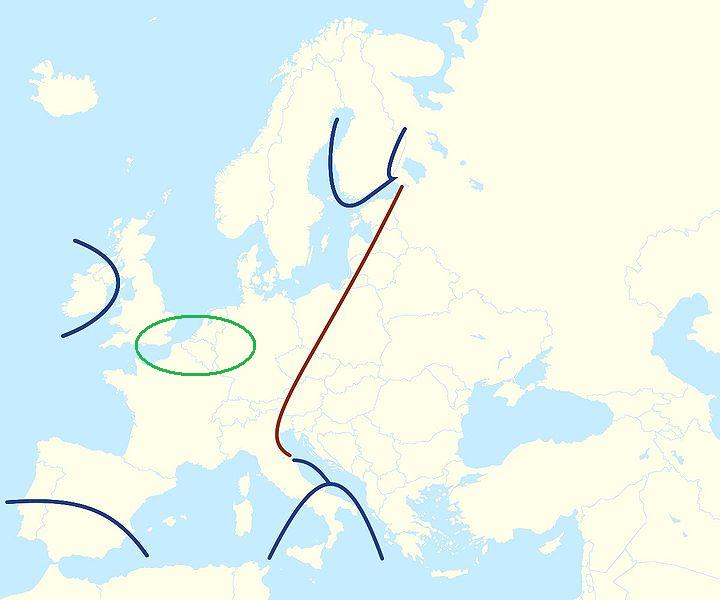
now here’s the same map with the hajnal line added. oh … oops!:

pinker - fig. 3.8 - hajnal line02

what i’ve been wanting to see is a map showing the reduction of homicide rates in europe over time. eisner has shown that the homicide rates didn’t drop all at once — they started dropping the earliest in england, belgium/netherlands, germany and switzerland — later scandinavia — and, much later, italy and the rest of peripheral europe (see this post for more details and nifty charts). here’s pinker summarizing eisner’s findings (from chapter 3 of Better Angels):

“[F]rom the 13th century to the 20th, homicide in various parts of England plummeted by a factor of ten, fifty, and in some cases a hundred — for example, from 110 homicides per 100,000 people per year in the 14th-century Oxford to less than 1 homicide per 100,000 in mid-20th-century London….

“Were the English unusual among Europeans in gradually refraining from murder? Eisner looked at other Western European countries for which criminologists had compiled homicide data. [T]he results were similar. Scandinavians needed a couple of additional centuries before they thought the better of killing each other, and Italians didn’t get serious about it until the 19th century. But by the 20th century the annual homicide rate of every Western European country had fallen into a narrow band centered on 1 per 100,000….

The Civilizing Process spread not only downward along the socioeconomic scale but outward across the geographic scale, from a Western European epicenter…. England was the first to pacify itself, followed closely by Germany and the Low Countries. Figure 3-8 [the one i half-posted above - h.chick] plots this outward ripple on maps of Europe in the late 19th and early 21st centuries.

“In the late 1800s, Europe had a peaceable bull’s-eye in the northern industrialized countries (Great Britain, France, Germany, Denmark, and the Low Countries), bordered by slightly stroppier Ireland, Austria-Hungary, and Finland, surrounded in turn by still more violent Spain, Italy, Greece, and the Slavic countries. Today the peaceable center has swelled to encompass all of Western and Central Europe, but a gradient of lawlessness extending to Eastern Europe and the mountainous Balkans is still visible.”

i wanted to see THAT on a map, so i drew one (NOT with crayons, although it kinda looks like it…). lighter shades=earlier drop in homicide rates; darker shades=later drop. i’ve indicated the century in which homicide rates began to drop for each region. and i’ve drawn in the hajnal line:

pinker eisner reduction of homicide in europe over time 02

finally, a footnote from pinker:

“There are gradients within each of these countries as well: the hinterlands and mountains remained violent long after the urbanized and densely farmed centers had calmed down. Clan warfare was endemic to the Scottish highlands until the 18th century, and to Sardinia, Sicily, Montenegro, and other parts of the Balkans until the 20th.”

previously: ibd rates for europe and the hajnal line and outbreeding, self-control and lethal violence and what pinker missed

(note: comments do not require an email. hello there!)

Follow

Get every new post delivered to your Inbox.

Join 93 other followers